✕
At RheinBrücke, we help enterprises reimagine their digital future by combining technology, strategy, and industry expertise. With scalable solutions and a business-first approach, we ensure your transformation drives measurable results and long-term growth.
Business Intelligence acts as a data manager, guiding enterprises through the complexities of their data landscape. It transcends basic data collection, providing a comprehensive view that helps decode intricate patterns and trends. Businesses can identify hidden connections and uncover previously unseen opportunities by leveraging BI. This holistic approach allows companies to transition from reactive to proactive, making informed predictions about market shifts and customer behavior.
The success of BI implementation centres around effective planning, stakeholder engagement, and skill development that maximize the benefits of BI for informed decision-making and business performance.
Ensuring that enterprise data can be identified, aggregated and transformed using ETL processes to make it accessible and useful.

Data aggregation from databases, APIs and Cloud services, integrating with data lakes for scalable storage.
Data preparation - cleansing viz. correcting errors and removing duplicates, transforming by standardizing formats & aggregating, and enriching data by adding contextual details.
Tools such as Power BI Dataflows and Power Query automate processes, enhancing efficiency.

BI technologies enable organizations to derive meaningful insights from their data, improve decision-making processes, and gain a competitive edge by understanding trends, patterns, and opportunities within their operations and market landscapes. It encompasses tools such as Azure Data Factory for ETL processes, Power BI for intuitive visualization, and Azure Analysis Services for advanced analytics, enabling organizations to extract actionable insights from data for informed decision-making and strategic planning.
Microsoft Fabric is a comprehensive platform designed to streamline data management and analytics across its entire lifecycle. By integrating key components such as data engineering, data science, real-time analytics, data warehousing, and visualization, it offers a unified approach to handling data efficiently.
Data Engineering is powered by Azure Data Factory, which orchestrates and automates data workflows and ETL operations. Data Factory also leverages this tool for effective data movement and transformation. In Data Science, Azure Machine Learning enables the creation and deployment of machine learning models for actionable insights.
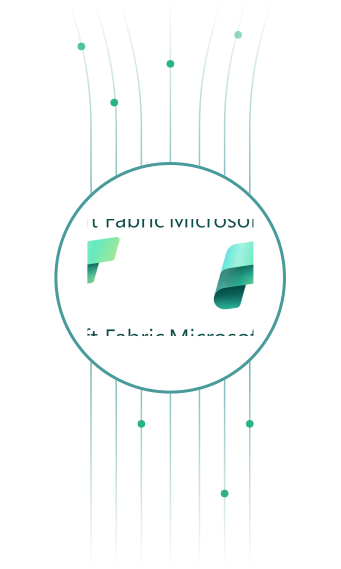
Our technology stack supports a diverse array of data visualization, business intelligence, and enterprise resource planning solutions, enabling comprehensive insights across business functions. Tableau provides a powerful, user-friendly platform for creating interactive dashboards and data visualizations, making complex data easily accessible for business users, while Qlik Sense offers similarly intuitive analytics capabilities. SAP Business Objects addresses enterprise-level reporting and analytics needs.
Anvizent streamlines data integration from multiple sources for real-time insights, and Google Data Studio provides an intuitive, cloud-based platform for customizable reporting. To support advanced analytics, we leverage Databricks for data processing and machine learning, and Snowflake for scalable data warehousing and seamless data management.
Revolutionizing Tech Solutions: Microsoft Dynamics 365 and Microsoft Technologies Lead the Way.
We integrate Power BI with Dynamics 365, enabling a cohesive and finely tuned data environment. Combining BI's analytical capabilities with Dynamics 365's ERP and CRM functionalities offers several benefits such as
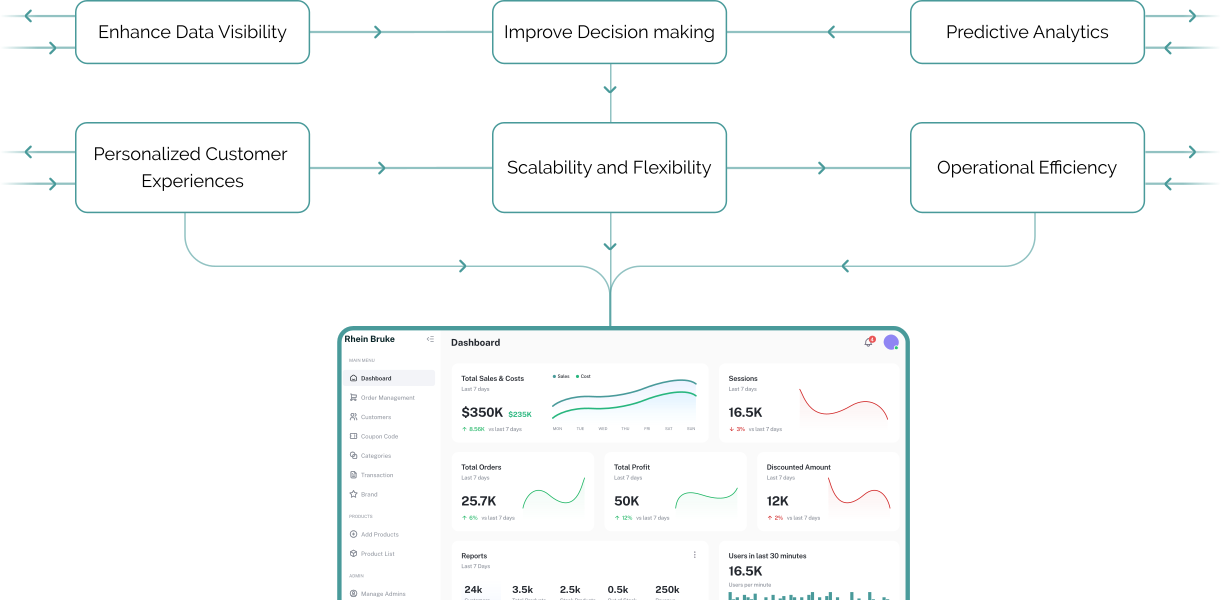
We are passionate about empowering your organization to make informed decisions with confidence. Our team of highly skilled professionals possesses unmatched expertise in diverse data models and cutting-edge analytics tools. As a Microsoft Gold Competency Partner, we work closely with you to unlock the full potential of your data.
Experience unparalleled speed and efficiency with our state-of-the-art technology and design capabilities.
Implement bespoke data models and solutions tailored precisely to your unique business requirements.

Rely on our comprehensive services for seamless support throughout your entire data journey.
Utilize our deep knowledge and experience in your sector to address and overcome your specific challenges.
RheinBrücke IT Consulting GmbH's Power Plant Analytics (PPA) tool was a transformative solution tailored specifically to the unique demands of the power plant industry. Unlike traditional ERP suites, PPA excelled in critical areas such as billing, revenue calculations, power generation scheduling, and management of power purchase agreements. With advanced features providing real-time access to comprehensive operational, financial, and market data, PPA empowered decision-makers to gain deep insights into plant operations and market profitability. The tool's analytical dashboards and self-service reporting capabilities enabled users to foresee opportunities, detect risks, and make informed decisions swiftly.
PPA enhanced decision-making through historical trend analysis and "What-If" scenario evaluations, assessing the impacts of operational metrics and potential disruptions. Field officers benefited from real-time data access via smartphones for proactive maintenance, while standard BI reports and dashboards facilitated comprehensive analysis. The seamless interface for MIS reporting minimized manual intervention, enhancing reporting accuracy and efficiency.PPA's modular design included functionalities for billing, scheduling, revenue management, and budget forecasting, ensuring streamlined operations and efficient resource management.
PPA's user-friendly design ensured ease of use with minimal training for business users. RheinBrücke successfully delivered a robust solution that enhanced operational and financial efficiency in the power plant industry, solidifying its commitment to innovative and impactful industry solutions.


“RheinBrücke IT Consulting's technical expertise makes me feel invincible. CCT has a talented pool of internal IT resources but sometimes that's not enough. Working with RB has taken a lot of weight off our shoulders; both the sheer volume of what we can handle together as well as the high level of technical expertise they bring to the table have greatly advanced CCT's abilities to adapt and evolve with our expanding global market. Nithish and Rajagopol are easy to work with and always have great ideas on how to solve our technical and business process issues plus they're just nice guys.”


“Congratulations to your team for successfully pulling off the “Automation of RMA” project using the “A-MAP Smart” mobile based application ! The legacy system was a laborious and time-consuming activity of data entry of the hundreds of Inspection entries, from the numerous Inspection sheets generated on a daily basis from the field, matching the claims against the supplied Sales orders and line details, entering all the warranty test information including customer purchasing & return data, creating disposition against the relevant warehouses and summarizing all the data for transfer to the sales teams for actual settlement of claims vide relevant sales orders.”


“Thank you for the continued good work on the ERP and Supply Chain project. Your Consulting, Technical, Functional and Project management expertise was evident and was very well appreciated by our staffs. I was also pleased with the flexible, easily approachable, transparent dealing with your team. Needless to mention I also appreciate how effectively you leverage the teaming with cross cultural teams with low cost geography for developmental resources while not compromising on the quality of deliverables to business. Keep up the good work.”

“I had been using RheinBrücke team as my extended arm for sometime now and I have really come to appreciate their depth of technical and functional knowledge of the product and their commitment to our end customers needs. They react quickly to new challenges and are always there for me to rely on.”


“We implemented Epicor ERP for one of our large Glass manufacturing facility in Middle East. Like any ERP implementations, even though the product was good, we faced initial hiccup and challenges during the implementation . This is where we came across the German based RheinBrücke IT consulting and took their support. They did a fantastic turnaround of the project. I enjoyed the transparent and efficient dealing with the company and came to appreciate their work. Now they have opened the Middle East operations and am positive they will do well due to their good service motto.”


"We were very impressed with the way RheinBrücke carried out their work. From analysis to implementation and post-production support, their analysis was always detailed and complete. It was easily understood by users, so different system extension options could be evaluated with all relevant information."

"Our challenges made us to embark on our ERP journey and after lots of analysis, we choose Epicor ERP for RAY Group. We also faced initial hiccup and challenges during the implementations. This is where we came across the German based Rheinbrücke IT consulting and took their support. We leveraged their services for past 12 months and from this experience, I can definitely say that they did a fantastic turnaround of the project. I enjoyed the open, transparent and efficient dealing with them and came to appreciate their work. I understand that they recently started their Middle east and Africas operations, I wish them good luck and every success."


“NGC Energy’s Epicor Implementation go-live happened earlier this year and at the end of Jan, we had successfully closed our Jan 2015 books in Epicor. This is a big milestone for all of us. It has indeed been a long journey, starting from inception, system study, training, pilot & finally the 1st month-end closing. During each stage, we received full co-operation from RheinBrücke teams. They had given us their unwavering support, with full dedication & positive attitude to make this project successful. During this entire journey, both teams faced many challenges & at times,…”


“The launch of the IDC in Chennai marks a pivotal step forward in our collaboration with RheinBrücke. This new centre will enhance our operational efficiency and growth potential and I would like to extend my thanks to everyone involved for their hard work in making this a reality.”

Bestes Neues Produkt Oder Dienstleistung- Software - Alle Anderen Losungen 2017

Stevie - Epicor EpicPay for the EMEA Market 2017

Epicor Partner of the Year 2016 & 2018

Stevie - L1 Epicor Support Team of the Year 2016

Stevie Company of the Year 2015 & 2017

Stevie People Choice Of the Year 2015 & 2016
Top IT Berater 2014-2015
Beste Berater Brand enis 2018

Stevie - Fastest Growing Company in Europe 2015 & 2016
Stevie Company of the Year 2015 & 2017